Once upon a time we made a video called Stylets & Bougies for Kiddos. It’s worth a view if you haven’t seen it, but it goes into the details on when we might consider a stylet vs. a bougie (vs. neither!) with pediatric airway management. Along the way, we mentioned the neonatal bougie that is up and coming and alluded to the idea that we might someday make a second video on that device specifically. This obviously isn’t a video, but it serves as the long-overdue follow-up.
This is the device, the neonatal bougie. Well, at least one of them:
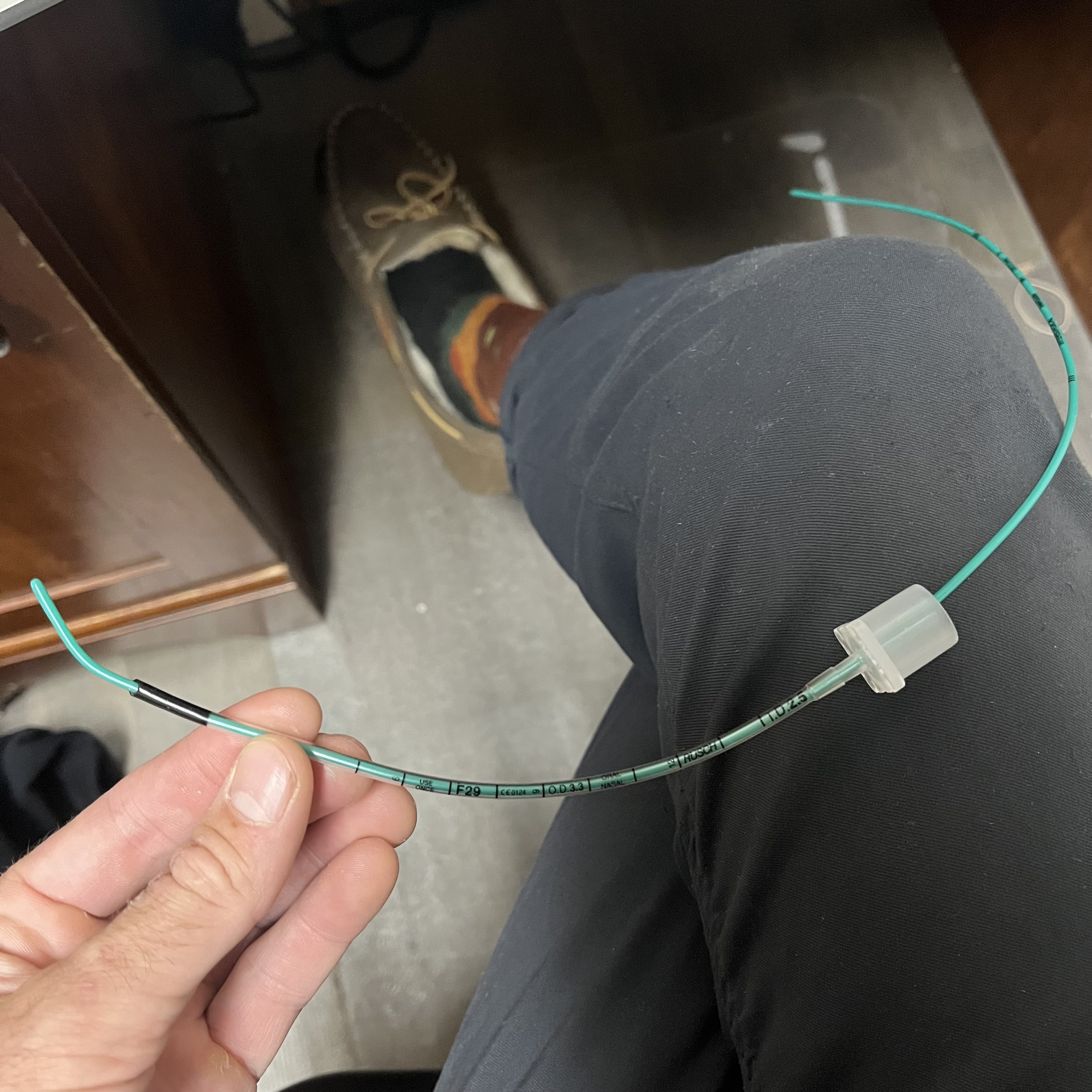
It’s a 6F size and, therefore, fits endotracheal tubes (ETTs) sized all the way down to 2.5mm. Which is all but the very smallest 2.0 ETT typically reserved for the very tiniest of neonates.
(and as a reminder, the 10F pedi bougie can fit down to a 4.0 ETT and the 15F adult can fit down to a 5.5)
That said, there is also a skinnier/ smaller device that is 5F and can fit the 2.0 tubes. But we haven’t actually seen this bad boy in real life yet: link to product page
And there is now one of those fancy hollow bougies that allows for passive delivery of oxygen with tube exchange or intubation. Compatible with the smallest 2.0 tubes! link to product page
(similar tech to the iBougie by VBM, link to product page)
For comparison, the standard baby rigid stylet is normally 6F:
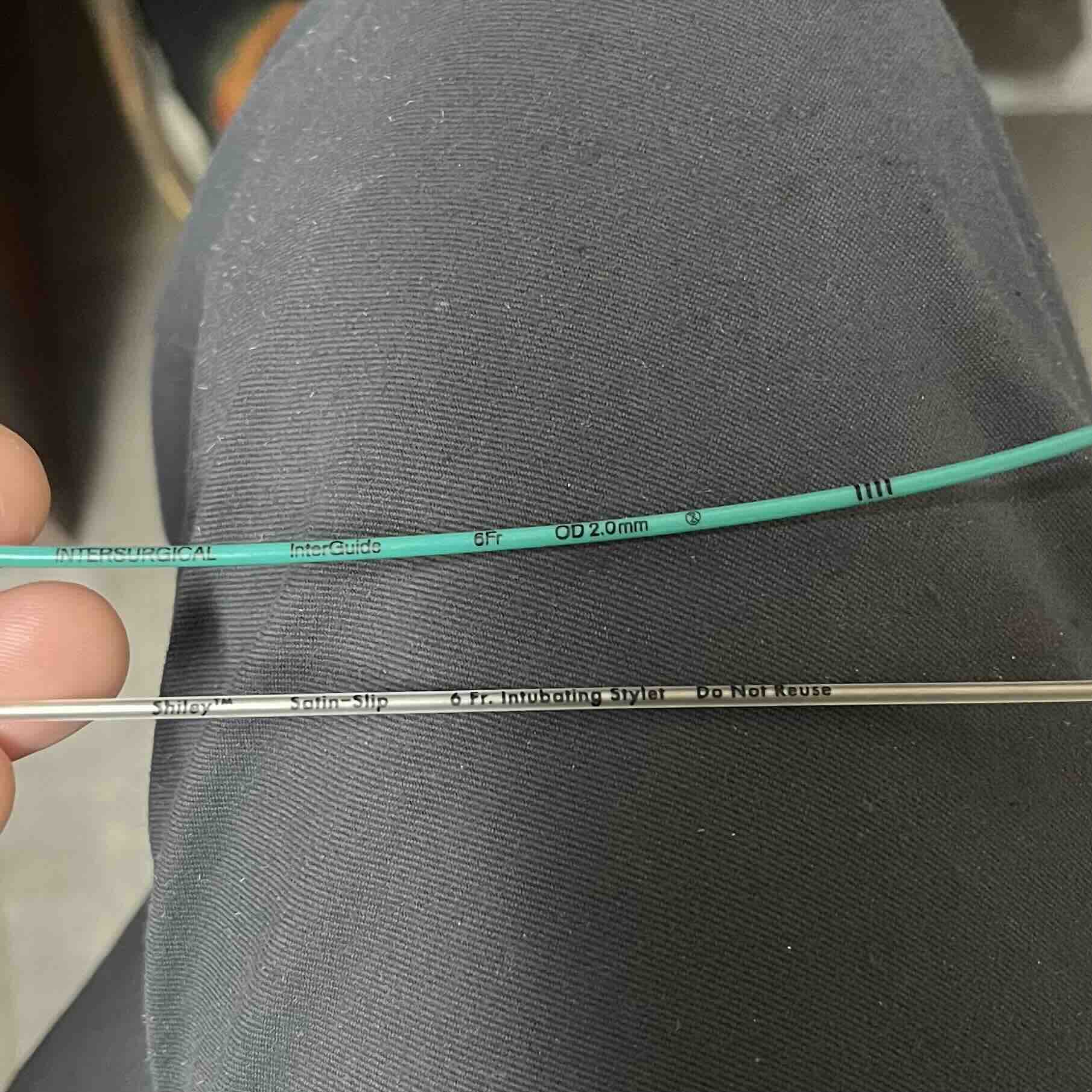
Purported uses for the thing are for intubation and for tube exchange. We’ll touch on both and then discuss opinions on it as a tool in general.
Intubation w/ the Neonatal Bougie
The primary use for the bougie in adult patients is to facilitate intubation, whether it is used routinely or reserved for difficult airways. The situation is a bit more nuanced in pediatric patients (see the video we mentioned at the start) and then even more so for neonates. The bougie is NOT often used for intubation in infants and neonates (rather, it is more commonly used for tube exchange - more on that shortly).
This low utilization is partly because there just hasn’t been much research on this practice - reasons cited would be a small data set in general and also ethical concerns related to “trialing” something new on babies. Another reason is that we often don’t need to use a stylet at all when intubating infants and neonates; and then when we do, we may defer to a more rigid stylet that allows us to shape the distal end to our needs. And then lastly is the fact that the smaller bougies perform less like the adult ones the smaller they get (this is primarily due to the fact the smaller ones are less rigid or more floppy), which means the psychomotor skill we have refined for adults doesn’t necessarily carry over to the neonatal-sized bougie.
Regarding the paucity of evidence:
- the largest data set on infant and neonatal airway management (under the heading NEAR4NEOS) didn’t even include bougie use in its data collection; see Foglia & friends, 2019
- the only paper we could find on the use/ technique of the neonatal bougie was a 2015 paper by Komasawa & friends that had anesthesiologists use the thing on manikins set up in different positions to simulate both normal and difficult airways
Then as for when we’d maybe want a rigid/ formable stylet for little bitties:
- hyper-angulated blades (same argument as with adults; also the GlideScope now goes down to a size 0 for littles under 1.5kg)
- markedly “anterior” anatomy
(and note that these suggestions mirror recommendations for general use of stylets, not necessarily the bougie, in this guideline: Long & Gottlieb, 2026)
Interestingly enough, however and on to deviate on a tangent, the use of a hyper-angulated blade in Pierre Robin sequence (the classic, mega-anterior neonatal airway) has been shown to be inferior to a standard straight blade. While the hyper-angulated blade provides a better view, actual tube placement is better with the straight blade. That said, this data is mostly manikin-based, so do with that what you will: Moritz & friends, 2021
And finally, this is what we mean by less rigid or more floppy:
In light of all of this, if one were to decide to use a neonatal bougie for an intubation attempt, here’s what we’d recommend:
- have a rigid stylet on hand as a backup
- designate an airway assistant to load the ETT
- do not preload the neonatal bougie
Regarding that last point:
We once upon a time made a few recordings on how to preload ETTs of various sizes onto the neonatal bougie. It can and does work OK, but the problem is that you have different techniques and considerations for each ETT size. That means sort of a separate skill set or game plan for each size. In the midst of what will likely be a stressful experience. So just avoid the whole thing and get an airway assistant. That said, if death by curiosity is of concern, the video is here: One Human Neo Bougie Techniques
One other thing to mention here is that it is OK to use the neonate bougie to facilitate front-of-neck access. But it’ll be a trach vs. a cric because the cricothyroid membrane is very small in babies. Not something most of us routinely do and hopefully it’ll never come down to that, but here’s a bit of casual reading on the idea:
Sabato & Long, 2016 - Can’t Intubate, Can’t Cxygenate in Children
Riva & friends, 2023 - Emergency Front of Neck Access in Infants
Haag & friends, 2023 - Narrative Review on FONA in Peds
And then for another take on neonatal intubation and use of the bougie, refer to this article by Vygon.
(just know that it was made by and is hosted on the website of the people that make one of these neonatal bougies…)
Tube Exchange w/ the Neonatal Bougie
The more common use for the neonatal bougie is as a tube exchanger. We might want to swap out an ETT in the infant or neonate for any number of reasons:
- tube that was initially placed is too small (whether from the start or due to a reduction in swelling)
- to replace an uncuffed tube with a cuffed one
- the bulb on a cuffed ETT has failed
The common theme here being a leak around the distal end of the ETT. This can be appreciated any number of ways. Just to name a few:
- an audible leak/ abnormal sound with each exhale
- mismatch between delivered and exhaled tidal volume
- failure of volume-time waveform to return to baseline
As a side quest, there is an interesting paper that we cited back in the day in the Vent Book v1 on troubleshooting a leaky cuff: Lauria & friends, 2019
Side quest 2.0 is that the new version of the vent book, currently out for peer review, includes much more detail on pediatric ventilation - worth a read if you haven’t taken a look yet: Rykerr Medical Vent Book
The procedure for doing the tube exchange is basically the same as for an adult, just in miniature.
Here is a video of a staged procedure using a manikin
And here is a video of an actual procedure
(and the paper that goes with this second video is linked from the video, but lives behind a paywall…)
Of note is that neither video uses a bougie, per se, rather they use a tube exchanger device. Which is kind of the same thing, just without the coude tip at the working end, with better distance markings along the way and a hollow core that allows delivery of air/ passive oxygenation during the procedure.
There is a decent amount of data to support this sort of tube swap thing and the best resource we’ve been able to find is this one: Miller & friends, 2025
And then a few pointers if one does find the need to do this sort of thing in practice:
- have all the airway/ intubation things ready just in case
- designate an airway assistant and lay out roles ahead of time
- use drugs for sedation and paralysis
Basically treat the thing as if it were a primary intubation attempt. Just in case.
General Thoughts on the Neonatal Bougie
Having only used the thing on manikins in a controlled setting and also having very limited experience with baby intubation, here’s the verdict:
- intubation - will keep the bougie on hand as backup and will lead with a rigid stylet
- tube exchange - will use the baby bougie (or similar exchanger) as the primary device
(leading with the rigid stylet for intubation doesn’t necessarily mean it has to be used/ left in place to pass the cords, we can always have an assistant/ partner remove it if need be; it’s just way harder to put the stylet in than it is to take it out and, therefore, makes sense to start with it in and shaped to how we anticipate it being needed)
If the baby bougie were a bit stiffer or had a metal core that allowed for it to be shaped to some degree, it seems it would be a bit more useful in primary intubation. That feature wouldn’t necessarily add value on the exchange side of things, but it also doesn’t seem that it would detract from it in any way.
(and if someone reads this and then makes such a device and then gets rich, please consider supporting the project!)
It could also be the case that the hollow, passive-oxygenation-capable baby bougie we cited above is, in fact, a bit more rigid and, therefore, could be the ideal tool. As before, if we get our hands on one, we’ll follow up with more nerdy content.